


Homage to Justice V R Krishna Iyer
By vigilindia 21:46 Articles , feature , gallery
Justice V R Krishna Iyer, former judge Supreme Court of India and a prominent human rights activist, a long time associate of Vigil India Movement passes away at the age of 100 on 4 December 2014.
Justice V R Krishna Iyer was a close associate of Rev. Dr. M.A. Thomas, the founder of Vigil India Movement. He has been a guidance force to the VIM team to strive for the protection and promotion of human rights at different capacities in the 70s to 90s and a recipient of the prestigious M.A. Thomas National Human Rights Award in 1998.
VIM expresses the heartfelt condolence to the demised soul and recalls the great memory in association with Justice V R Krishna Iyer by republishing his acceptance speech for M.A. Thomas National Human Rights award 1998.


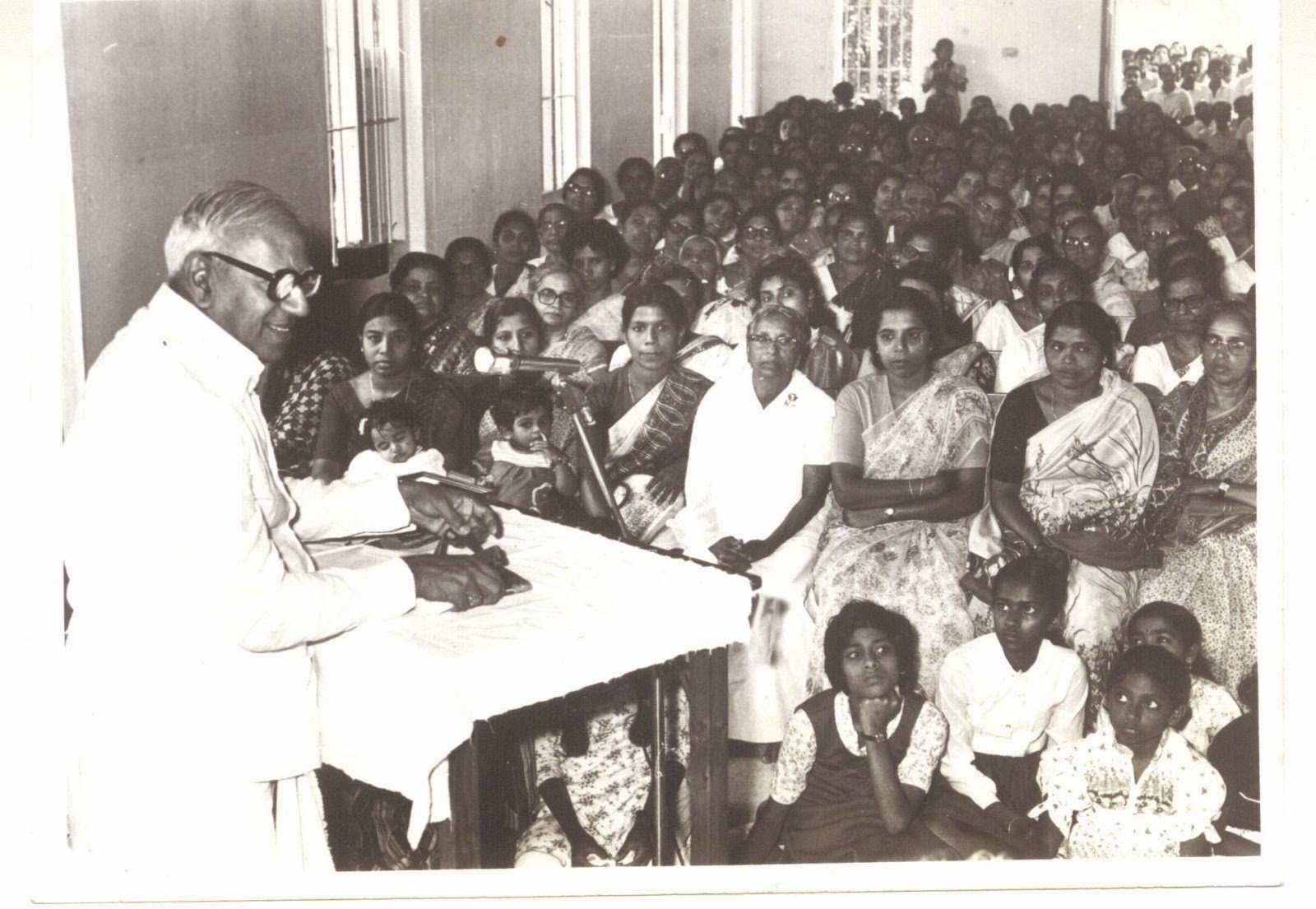

A SOULFUL RESPONSE TO VIGIL INDIA’S GENEROUS GESTURE
I am grateful to the “VIGIL INDIA MOVEMENT’ and the distinguished Judging Committee for linking my name with a great India, a noble human and global gentleman, Rev. M.A. Thomas, whose life, simple, selfless and sacrificing was a cast in the mould of Jesus and shaped by the Gandhian ethos. The passion of Christ on the Cross has been an inspiration for generous of humankind, a symbol of spiritual protest against imperial injustices and intolerant fanaticism. His implacable opposition to the suppression of human personality and gender justice was also a divine summons to human compassion in the place of than-attic theology and mono-manic marketisation! Rev. Thomas strode the world in the hallowed lift of Christ and every cell of his body and soul struggled for human rights and justice, geared to higher values and resistance to corruption and exploitation.
His vision was cosmic, mission humanitarian and passion value-based liberation. Vigil India was his torch motivated for social transformation where sharing and caring and dynamic fraternity is the rule of law and life.
I am too humble to deserve the distinction now conferred but so too am I too small to challenge the unanimous choice of the panel since I have profound respect for each member and his integrity, mellowed experience in society and wider perception of human rights culture. So I submit myself to his ceremonial function. I hate to be honoured for an awards and rewards, citation and cash appetizers. What special contribution to society have I made to deserve this magnificent need? My conviction, I confess, is compassion for all living creatures best expressed by Blake when he poetized:
“ A dog starve’d at his master’s gate
Predicts the ruin of the state
A horse misus’d upon the road
Calls to Heaven for human blood”.
And did not burns weep in verse: “Man’s inhumanity to man make countless thousands mourns”. Universality of creation and unity of humanity keeps my being vibrant. Why? Because Donne’s diction dwells in me:
“We man is an Island, entire of it self:
Every man is a piece of the Continent,
A part of the main, if a clod be washed away by the sea,
Europe is the less; as well as if a promontory were,
As well as if amanor of they friends or of thine
Own were, any man’s death diminished me, because
I am involved in Manking;
And therefore never send to know for whome the bell tolls;
It tolls for thee”.
My fundamental philosophy and basic value set are derived from a strange confluence of Swami Vivekananda, Karl Marx and Comrade Jesus with a sprinkling of the finer humanism of Prophet Mohammed. In sum, I am at simplicity in life, search for happiness in a universal just order, detest servility to gain glory, doubt, with honest skepticism, every proposition but date to accept facts even if allergic to elite opinion and anathematic to bightrow bosses and above all I held, deep in my soul, that I am human and so anything that distress any living creature deeply disturbs me and commands me into curative action, even if in vain. I am aware of my weakness and feel painfully ineffectual when injustice is inflicted on fellow creatures. I am a home of lost causes, martyr of pursuits of noble futility, victims of unwitting misunderstandings and nidus of unpopular, maverick noises. Still I must and hopefully will battle for human justice in all its dimensions, even if denounced and defeated by more powerful authoritarians to dissent against evil is a duty.
Permit me friends to do first things first. So, I bow, in profound reverence, before the cherished memory of that incomparable humanist Rev. M.A. Thomas. We need him every hour, every moment in our asuric system, to defend the moral order, spiritual culture and probity in public life. His diamond hard integrity, his rare commitment to truth, liberty and submission to the supremacy of eclectic values, sans which life losses its sublimity and the universe its divinity, made me gravitate towards him. Rev. Thomas was a one-man campaigner against the decline and all of Bharat’s rich heritage, happily composite, and morally Gandhian. What a piece of work was Thomas, gentle and compassionate, noble in bearing, a holy human in luminous locomotion, deep in concern for justice, truth, amity among communities and a heart tuned to the travails of the lowliest and the lost. He wrote to me few days before his death about his illness and possible terrestrial exit. His premonition proved true and plunged me and that large fraternity which looked to him for a lead like a lodestar in grief. Today, his magic memory still belights this dark world and gives us a heritage of hope. Dear brother Thomas, salutations to your radiant, tho’ invisible, presence on Indian earth where a pestilent congregation of foul vapours pollutes our biosphere and glorifies hedonist greed and chauvinist bombs while millions starve or suicide in this Barabbaque order devoid of purity and probity in private and public life! What a pity the nation is riddled with rouges, rascals and free booters a s well as criminalized politicians and political criminals.
You, Dr. Thomas, were the founding father of ‘Vigil India’. Eternal vigilance is the price of liberty and my homage to you is blended with a tryst to battle against corruption, gender outrages, glitterati immorality and violation of human rights of vulnerable humans by those dressed in ‘a little brief authority’ but ‘strut and fret the hour’ robbing the resources of the nation and inviting MNCs to colonise our national economic space, even sensitive areas. Colonialism is the opium of the creamy layer who are mindless in signing away our Swaraj. We miss you Rev. M A Thomas but your spirit will stll lead kindly light amidst the encircling gloom.
I am in a demoralized mood, a spirit of unworthiness, a feeling of aloofness to cash wards and flattery thro citations. My mind is elsewhere, my search is in a different sphere, my sunset age is shell-shocked by the scenario of megalomanic vanity, worldly adventurous and ambitious gold rush. They are ‘the hollow men’, …… the stuffed man……….. headpiece filled with straw’! Alas, how free I feel, having jettisoned these money-making, tuft-hunting crazes for continuance in power as different incarnations!
Currently, gross materialism, hostile ethnos and communal ethos, by a python-like process, crushed the humanist code of ethics. Therefore, a transformation, at once material, moral and spiritual, without inhibiting the infinite creative potential within everyone, the last pariah included – is the only answer to the challenges of violence, greet, sex and other bestial vices. Vigil India’s tasks are hard and heavy in the battle for human rights and against inhuman wrongs.
Be that as it may, I plead my inability to be happy in the company of the cash and carry glitterati. While it is the wisdom of the ‘Vigil India Movement’ to present a hundred thousand rupees to me, but once presented, it becomes my option to use that sacred sum for human rights cause. Not a single rupee out of this noble amount will belong to me and the entire sum, I publicly declare, will go to the study of public law in the human rights domain. May be, an authentic institution capable of energizing human rights education and activities like the National Law School of India University, may accept the trust.
I seek to place before you a mental page from my life autobiographical but authentic before I close.
My holistic tryst with destiny is humbly to strive for a New World Order which makes the biosphere a hallowed home for all humans and other ecological species in an environment of harmony and compassion, thro a lovely synthesis of value, material and spiritual. Such a cosmic symbiosis where the distant stars and leaves of grass have a underlying unity is the lesion of Sri Satya Sai Baba, Sri Narayana Guru, Sri Aurobino, a host of leaders of sublime thought and a sages of the Upanishads. This dynamic transcendentalism, with its paradigm shift, replaces the currently fashionable but fragmented materialst ethics with a new noetic ethic, ecological vision and self-realisation process. Who am I? is a perennial interrogation which baffles my consciousness, with the iron curtain (or translucent veil) dividing life from Death. In flashes I perceive that God (or the Supreme Intelligence of Creative Power) ‘sleeps in the mineral, awakens in the vegetable, walks in the animal and thins in man’. If supra-mental faculties a re kindled, divinity meets and mates with humanity where consciousness becomes the blissful resource of the universe. This integral yoga, intuitive, subjective, yet scientific and spiritual is the profound idiom the deep fulfillment of TAT TVAM ASI (Thou art That).
The kingdom of God is within you, said Christ. In the seashore of world children play, says Gitanjali. These are the matrices and glimpses of my philosophy of life, shared in the long-ago days when my wife and I sat near the sea in my Tellicherry home and the very process was joy. Life is a verb, not a noun, a perennial process, not a final product.
I am four score and three; but in the end is the beginning, a discovery of the manifesto of humanity an antyodaya sarvodayas project too deep for words. This vistarami vision in my dream, where secularism and socialism, diginity and fraternity are invested with a celestial significance. A micro-beginning of an sdyssey towards the infine! It is but a reverie, distant from the reality. And the recurrent lines of Tennyson haunt me, day after day:
“ So runs my dream: but what am I?
An infant vrying in the night:
An infant crying for the light
And with no language but a cry”.
Finally, I express my profound feelings to “Vigil India” for conferring a distinction I hardly deserve, except as a Camp follower of the Rev. Dr. M.A. Thomas Brigade.
Justice V R Krishna Iyer
10-8-1998
SPEECH BY ADVOCATE K.PRATAP REDDY, PRESIDENT OF VIGIL INDIA MOVEMENT ON THE OCCASION OF THE GOLDEN JUBILEE CELEBRATIONS OF ECC AND BIRTH CENTENARY CELEBRATIONS OF THE LATE REV. Dr. M.A.THOMAS, FOUNDER OF THE ECC AND VIM
By vigilindia 20:18 Articles , feature , gallery
SPEECH BY ADVOCATE K.PRATAP REDDY, PRESIDENT OF VIGIL INDIA
Rev.Dr. Isaac Mar Philoxenos, Chair Person of this function
Hon’ble Shri M. Hamid Ansari, the Vice President of India
Hon’ble Shri. H.R.Bharadwaj, Governor, Karnataka,
Hon’ble Shri Siddha Ramayya, Hon’ble Chief Minister, Karnataka,
and other dignitaries on the Dias and Ladies and Gentlemen,

I feel it as a great honour, to be invited to address this August gathering at these two very glorious celebrations; the Golden Jubilee of ECUMENICAL CHRISTIAN CENTRE and the Birth Centenary of a legendary figure the late Rev. Dr. M.A. Thomas, founder of both these Humanitarian Institutions, ECC and Vigil India
I had the privilege of being closely associated with the late Rev. M.A.Thomas for two decades and also with these two historic institutions he founded. My association with the late Rev. Thomas started when he was traveling around in this country to mobilize and identify people in different parts of India
I learned from Rev. M.A Thomas that the expressions of “Ecumenism” or “ecumenical” are not confined to Christian theology but have a much wider meaning pertaining to the unity of Humanity.
Rev.M.A. Thomas’s philosophy and motto about the work of ECC was: - “One Family Under Heaven”. He demonstrated the practical applications of this motto in all his actions through the ECC as well as through the work of the Vigil India Movement. This motto of Rev.M.A.Thomas was synonymous with the ancient Hindu concept of VASUDAIVA KUTUMBAKAM. He inculcated the spirit of inter-religious collaboration even from his student days. He was the secretary of the “Inter-Religious Student Fellowship” founded by late Dr.Sarvepally Radhakrishnan, Former President of India
At the same time Rev.M.A.Thomas never kept himself aloof from the contemporary freedom movement. He was in close association with Mahatma Gadhi, Jawahar Lal Nehru and Jaya Prakash Narayan and was a regular visitor to SEVAGRAM. Rev.M.A.Thomas was a true Nationalist, Secularist and Humanist. Whenever the country was bleeding, either on account of communal riots or otherwise, any where in the country, Rev.M.A.Thomas raised his voice with concern which were echoing from both these institutions, ECC & Vigil India. At the height of the Babari Masjid controversy Rev.M.A.Thomas took very active part to solve the problem. In response to that Shri Ashok Singhal, the then president of the Vishwa Hindu Parishad visited Rev. M.A Thomas and promised to work on the lines suggested by Rev. M.A.Thomas.
In his CRUSADE for protecting the Human Rights, late Rev.M.A.Thomas adopted, and never deviated from the Gandhian path of peace and Non-Violence. While being a puritan Christian in his personal life, late Rev.M.A.Thomas remained a true Gandhian, a true humanist, a true ecumenist in its real sense and spirit. It was, indeed, rare combination of following the personal faith and demonstrating the public commitment. This unique quality distinguishes the late Rev. M.A.Thomas from many other distinguished leaders of India
The most important factor in his crusade for protecting the fundamental human rights and values is that, throughout his life he was involving himself in empowering every single individual. Empowerment of the people was his life’s mission. He established a wide national network of grass root level human rights activists belonging to all religions and all sections of the society. He was very closely associated with “AMNESTY INTERNATIONAL” and was the President of its Indian Section.
Let me conclude with my humble personal Note.: While I am not boasting of knowing large number of people in my life, but I would say that among the men I met, and I worked with, I found late Rev. M.A.Thomas was the most loving and lovable person, and the best human being I ever met. Though Rev. Thomas departed from this world physically but he is still alive in our Hearts and Minds for the last two decades and shall continue to live as long as Human values are respected. I also pray that these institutions, ECC and Vigil India founded by him will continue to serve the people of our beloved country and the Humanity at large and For Ever.
K.PRATAP REDDY
Status of Migrant Workers in India - an overview
By vigilindia 09:11 Articles , feature
Status of Migrant Workers in India – An Overview
Migration is not a new phenomenon in the history of a global society. In fact, the movement of population from place to place is one of the earliest social phenomena and is an important feature of human civilization. Migrations have taken place due to various social and cultural disorders in the history. In general, the primary causes for migration of people is in search of livelihood and survival. Migration in India has existed historically and has mostly influenced by social structure and patterns of development. One cannot deny that the large numbers of people have been forced to migrate from their native place during the colonial period and since independence the development policies have accelerated the process of migration either voluntarily or by force in terms of employment and survival. So, this paper is an attempt to highlight a few major factors and components on the issues related to the impacts of migration.

Reasons for Migration:
According to Indian Census 2001, the reason for migration have been classified in to several categories i.e. work/employment, business, education, marriage, moved at birth and moved at marriage etc., It is observed that employment among males and marriage among females are the main reason for migration. But in reality today both men and women are equally migrating from their place of origin in search of work/employment. Socio-economic factors, extreme poverty and debt crisis are major causes for work related migration. Migration in India is predominantly within state and state to state and it depends on source of livelihood. The total migrants as per the census of 1971 are 167 million persons, 1981 census 213 million, 1991 census 232 million and 2001 census 315 million.
Employment opportunities for the migrant labourers, particularly to the forced migrants are highly available in three major sectors i.e. construction, brick or quarry chambers and domestic household works. It is estimated that there are at present around 80 million migrants of which, 40 million are in the construction industry, 20 million are domestic workers, 2 million are sex workers, 5 million are call girls and somewhere from half a million to 12 million work in illegal mines otherwise called “small scale mines”.[1]
Plight of Forced Migrants:
Migrants are inherently vulnerable as subjects of Human Rights from the time they leave home to initiate their migration.[2] Majority of migrant workers particularly the unskilled are forced to migrate from their place for survival and they are solely depend on their employer for want of basic necessity to adjust themselves in the new locality, which is culturally and traditionally far from their native place. In addition to that frequent movements from one place to another lead them to lose certain entitlements they enjoyed in a place where they lived before migration. Forced migrants and their families are often land up in bondage and trafficking.
Bonded Labourers:
The employers particularly the owners of construction companies, brick chambers and quarry chambers exploit this situation and harass the labourers as slave. They have a wide network across the country and through the network they trace the people who are in extreme poverty and debt trapped and offer them to clear all their dues and in return made them to work in their chambers as bonded labourers. Those who have been trapped as bonded labourers work 12 to 16 hours a day with a very little wages and often their families too work tirelessly. Most of these workers are from families that have for generations toiled in construction companies, brick units and quarry units in different parts of the State and are not aware of their rights or the welfare measures the State and Central governments offer them. People from Bihar, Odisha, Utter Pradesh, West Bengal and Tamil Nadu are the major victims of bondage.
Bonded labour exists mainly in the informal and unorganized sectors, which employ around 90 percent of Indian Labour force. This type of slavery used to be more common in rural and urban brick chambers and quarry chambers, where as the mobility of outsiders are strictly controlled. However it is also very common in domestic house hold works, carpet industries, matches, cigarettes and crackers industries and in manual scavenging in all major cities.[3]
Domestic Workers:
Most domestic workers are from the marginalized sections of society and a large number of them are Women and Children. Each household in urban and semi-urban employs children and women as baby sitters, domestic helpers with minimum wage and they work almost 24 hours cycle. 92% of the domestic workers are women, girls and children and 20% of these females are under 14 years of age, as per a study conducted by the organization “Social Alert”. Census 2001 indicates that about 185, 595 children are employed as domestic workers and in dhabas (roadside tea and food stall). Employers prefer children since they can make children to work long hours with minimum wage. Easy to handle them and in no way they can form union and demand more wage. Women and Children those who are employed in the households often beaten up and sexually harassed by the owners. Especially the girl children have been facing physical and emotional abuses and they are not allowed to freely move with others.
Human Trafficking:
Virtually every country is affected by this crime. Women and Children are the major victims of human trafficking, which is an extreme form of Human Rights Violation. In India a large number of children and women are trafficked not only for the sex trade but also for other forms of exploitation. Trafficking in children is on the rise and nearly 60 percent of the victims of trafficking are below 18 years of age. Majority of the trafficking is within the country but there also large number trafficked from neighbouring Nepal and Bangladesh. Child In Need Institute (CINI) based at Calcutta had come out with different stories that most of the tribal youngsters in Jharkhand State volunteer in to commercial sex work. A study of CINI- Calcutta revealed that these tribes were earlier employed in Construction Company as labourers and after the work they were sexually tortured by the Contractors. Instead of being tortured every day at workplace, they have decided to volunteer full time in sex trade.
Excerpts of Reported Cases of Violations:
1. The revenue divisional officer in Kancheepuram district rescued 13 bonded labourers from a rice mill after being tipped off by the International Justice Mission. The workers were released on Thursday night following a rescue operation conducted by the RDO Dr M Veerappan along with IJM volunteers. These labourers were brought out of Mohan Chetty Rice Mill after five to six years of bondage, an IJM spokeswoman said. The operators of the Mohan Chetty Rice Mill paid the victims approximately `50 to `60 per person, per day, which is below the Tamil Nadu Minimum Wage of `136.02 per day. The labourers were made to work for more than 12 hours each day. The mill owner also denied the labourers freedom of movement and the freedom to work outside of the facility. The RDO issued release certificates to the 13 bonded labourers, officially identifying them as victims of bonded labour and entitling them to government rehabilitation funds. – The New Indian Express 22 Sept 2012
2. Forty bonded labourers were rescued from brick kilns in Jammu and Kashmir's Budgam district, an NGO claimed today. Bonded Labour Liberation Front led by activist Swami Agnivesh said the labourers were rescued from the brick kilns in Budgam district last week. Bonded labourer Ratnabai Sahoo, who managed to escape, said, "I have been working with my family for the last 11 years. Not for once have we been allowed to go back to Chhattisgarh. We are paid Rs 700 as for the entire week wages. "When we asked the brick kiln owner to allow us to go home, he said you have to pay Rs 3 lakh which you had taken as loan, then only you will be allowed. I and my son were thrashed very badly but we managed to escape somehow from their custody. "After we left, my husband was beaten and tortured mercilessly," she said. Commenting on their social conditions, Agnivesh said, "These labourers have been working in the brick kilns here for the last eleven years. We rescued some of them in February- March this year and sent them back to Chhattisgarh." "But in Chhattisgarh, these labourers were not adequately rehabilitated," Agnivesh alleged. – PTI news 5 September 2012
3. A 15-year-old trafficking victim was rescued by a joint team of Agra police, NGO Shakti Vahini, and NCPCR (National Commission for Protection of Child Rights). The girl, from Darjeeling, had been brought to UP and was being forced into marriage. She was rescued from a house in Tundla-Agra Road on September 6. The girl was trafficked on September 1. A missing report had been filed after the girl's mother complained to police. The mother suspected one Arun, who stays in Agra. After running from pillar to post, the victim's mother contacted Shakti Vahini, which reported the matter to NCPCR. Raids were conducted and the girl was finally rescued. During counselling, the girl said trafficker Arun had brought her to Tundla by Mahananda Express. From Tundla she was taken to Agra. The girl also said the trafficker was showing her around to sell her off. – Times of India 9 September 2012
Constitutional Provisions:
Migrant work forces are subject to torture, exploitation and bondage since the migrants are heavily depend on the employers. The Government of India made an enactment in 1979 of the “Inter-state Migrant Workmen (Regulation of Employment and Conditions of Service) Act 1979”. Including this under the Constitution of India, there were about 44 acts have been enacted catering to different aspects of labour namely, occupational health, safety, employment, training of apprentices, fixation, review and revision of minimum wages, mode of payment of wages, payment of compensation to workmen who suffer injuries as a result of accidents or causing death or disablement, bonded labour, contract labour, women labour and child labour, resolution and adjudication of industrial disputes, provision of social security such as provident fund, employees’ state insurance, gratuity, provision for payment of bonus, regulating the working conditions of certain specific categories of workmen such as plantation labour, beedi workers etc.[4]
Migration and Law:
I wish to state the emancipated Acts which are available for the commons use. But in midst of all the vulnerability prevails.
Name of the Act
(a) Labour laws enacted and enforced by Central Government
1. The Employees’ State Insurance Act, 1948
2. The Employees’ Provident Fund and Miscellaneous Provisions Act, 1952
3. The Dock Workers (Safety, Health and Welfare) Act, 1986
4. The Mines Act, 1952
5. The Iron Ore Mines, Manganese Ore Mines and Chrome Ore Mines Labour Welfare (Cess) Act, 1976
6. The Iron Ore Mines, Manganese Ore Mines and Chrome Ore Mines Labor Welfare Fund Act, 1976
7. The Mica Mines Labour Welfare Fund Act, 1946
8. The Beedi Workers Welfare Cess Act, 1976
9. The Limestone and Dolomite Mines Labour Welfare Fund Act, 1972
10. The Cine Workers Welfare (Cess) Act, 1981
11. The Beedi Workers Welfare Fund Act, 1976
12. The Cine Workers Welfare Fund Act, 1981
(b) Labour laws enacted by Central and enforced by both the Central as well as the State Governments
13. The Child Labour (Prohibition and Regulation) Act, 1986.
14. The Building and Other Constructions Workers’ (Regulation of Employment and Conditions of Service) Act, 1996.
15. The Contract Labour (Regulation and Abolition) Act, 1970.
16. The Equal Remuneration Act, 1976.
17. The Industrial Disputes Act, 1947.
18. The Industrial Employment (Standing Orders) Act, 1946.
19. The Inter-State Migrant Workmen (Regulation of Employment and Conditions of Service) Act, 1979.
20. The Labour Laws (Exemption from Furnishing Returns and Maintaining Registers by Certain Establishments) Act, 1988
21. The Maternity Benefit Act, 1961
22. The Minimum Wages Act, 1948
23. The Payment of Bonus Act, 1965
24. The Payment of Gratuity Act, 1972
25. The Payment of Wages Act, 1936
26. The Cine Workers and Cinema Theatre Workers (Regulation of Employment) Act, 1981
27. The Building and Other Construction Workers Cess Act, 1996
28. The Apprentices Act, 1961
(c) Labour laws enacted by Central Government and enforced by the State Governments
29. The Employers’ Liability Act, 1938
30. The Factories Act, 1948
31. The Motor Transport Workers Act, 1961
32. The Personal Injuries (Compensation Insurance) Act, 1963
33. The Personal Injuries (Emergency Provisions) Act, 1962
34. The Plantation Labour Act, 1951
35. The Sales Promotion Employees (Conditions of Service) Act, 1976
36. The Trade Unions Act, 1926
37. The Weekly Holidays Act, 1942
38. The Working Journalists and Other Newspapers Employees (Conditions of Service) and Miscellaneous Provisions Act, 1955
39. The Workmen’s Compensation Act, 1923
40. The Employment Exchange (Compulsory Notification of Vacancies) Act, 1959
41. The Children (Pledging of Labour) Act 1938
42. The Bonded Labour System (Abolition) Act, 1976
43. The Beedi and Cigar Workers (Conditions of Employment) Act, 1966
44. The Unorganized Workers’ Social Security Act, 2008
Despite of several acts and regulations, the atrocities and exploitation against migrant labourers are becoming unavoidable because the migrant work force is predominantly in the unorganized sector and it is very difficult to document the statistics and track the ground situation. Several measures have been taken to trace the problems of the migrant workers by several institutions but only few cases are rarely reported and brought in to the notice of concern departments. It is because of the backing of the politicians, the employers keep exploiting the migrant workers.
Conclusion:
Migration in India is mainly within the Country. Unfortunately, proper statistics on migration workers is not available. It is practically difficult to study the nature and dimension of migration in details. NGOs and Research Institution, who have been active in empowering the migrant workers, regularly updates the problems faced by migrant workers within their capacity. But it is not sufficient enough to strive to protect and promote the rights of the migrants workers across the country. In the struggle to protect the migrant labourers, the government, non-governmental organizations, civil society, pressure groups have to play an important role. Law cannot be the only instrument to take care of all until and unless the people should aware of the law and enact accordingly. So let us jointly uphold the rights of the Migrants by being human rights defenders.
*John VM Juliana is currently serving as Programme Manager, Vigil India Movement, Bangalore. He has served several National and International Development and Programme Centers including the Ecumenical Christian Centre, Whitefield as its Programme Secretary.
[1]B.K. Sahu – Migrant Workers: Present Position and Future Strategy Towards Social Security
[2]N. Ajith Kumar – Vulnerability of Migrants and Responsiveness of the State: The Case of Unskilled Migrant workers in Kerala, India
[3]Modern Slavery in India: Cases of Bonded Labour
[4]Ministry of Labour and Employment – Labour Laws and Other Regulations for the 12th five year plan (2012-17)
Peace, Security and Human Rights in the Emerging Geo-political Contexts
By vigilindia 01:54 Articles , feature
Mathews George Chunakara[†]

Although the world has witnessed many changes during the past two decades, the quest for security and peace remain only as a dream for millions of people in this world as their vulnerability fosters a climate of fear which undermines security at all levels in their day to day lives. It is in this context that the United Nations High-Level Panel on Threats, Challenges and Change called for a new security consensus “between alliances that are frayed, between wealthy nations and poor, and among peoples mired in mistrust across an apparently widening abyss.” This highlights the indivisibility of security, economic development and human freedom and the idea that “we all share responsibility for each other’s security”. Here, the essence of peace and human rights is based on the cardinal principle of human security. Human security is “freedom from want” and “freedom from fear”.
Emerging geo-political trends
The challenges to peace and security in today’s world are faced with complex issues and implications in the emerging geo-political contexts. As a matter of fact, geo-politics and geo-economics of the emerging World Order has been shaping the peace and security architecture of the world today. The decline of the authority of the dominant power as well as the emergence of new powers is playing different roles in this process. There are several significant trends being emerged, we see more precisely in the context of the new global order and in the context of current geo-political realities. One such trend becomes more evident as we see the decline of the “U.S. influence” and the “rise of new power blocs”. The rise of new power blocs poses threats to economic, political and strategic interests of the U.S. This emerging trend points to various other factors: the power shift taking place at the world level, the decline of the U.S. and other countries in the West in a context of high interdependence among nations, the impact of the growing role of religion in a globalized world, especially due to the consequences of politicisation of religion, the decline of the secular concept to the handling of public affairs as well as international relations. Another significant trend is the increasing level of state actors participating in the institutionalised international system. The number of state actors has multiplied by more than four times since the founding of the UN in 1945. States alone are not the only influential actors who can exert any weight in the international system, but a number of transnational forces such as multinational companies, non-governmental organisations and international agencies are also capable of influencing the international systems today.
A more specific question on the role of the U.S. in the emerging global context was raised by Bruce Jones, director of the Managing Global Order initiative. In a paper published last year in Foreign Policy, under the title ‘Managing a Changing World’, Jones raises the question: “Did American overstretch amplify the impact of the rise of the "emerging powers?”. It is a fact that “while America's resources were bled by two wars, new potential rivals are growing around their spheres of influences whether in the form of economic, political or military might”.
In 2004, Charles Krauthammer one of America’s foremost political analysts and columnists projected a manifesto for "American Foreign Policy for a Unipolar World" and he boasted:
It took three giants of the twentieth century to drag us into its great battles: Wilson into World War I, Roosevelt into World War II, Truman into the Cold War. And then it ended with one of the great anticlimaxes in history. Without a shot fired, without a revolution, without so much as a press release, the Soviet Union simply gave up and disappeared. It was the end of everything--the end of communism, of socialism, of the Cold War, of the European wars. But the end of everything was also a beginning. On December 26, 1991, the Soviet Union died and something new was born, something utterly new-a unipolar world dominated by a single superpower unchecked by any rival and with decisive reach in every corner of the globe.
Not too long since Krauthammer claimed about America’s unique role in a post-Cold War global context, Fareed Zakaria, then Editor of the Newsweek reflected upon ‘The Post-American World’ and the consequences of America’s miscalculations. While analyzing the reasons for the decline of American power and the anxiety of Americans, Fareed Zakaria said Americans see that ”a new world is coming into being, but fear it is one being shaped in distant lands and by foreign people”. Giving a long list of areas where the U.S has been pushed aside or declined from its original top rank and domination in the economic and political arena, Fareed Zakaria said, “only ten years ago, the United States would have serenely topped almost every one of these categories”.
Robert B. Zoellick, President of the World Bank Group, in a speech at Washington's Woodrow Wilson Centre for International Scholars last year argued that the Third World has come to an end. It was actually an acknowledgement, rather a belated one, of the fact that the geo-political configuration of the world has totally changed from what it was in 1944, when the Bretton Woods system was born. He promoted the idea that there should be an advocacy of “modernising multilateralism for a multi-polar world”. He was also focussing on the urgent need of reforming the World Bank and the IMF before the Bretton Woods System becomes a total failure. He further elaborates about the end of the "Second World" with Communism's demise in 1989 and the end of the Third World with the global economic crisis of 2009. The First World has declined. The old world of fireside chats among G-7 leaders is gone.
The emergence of the multi-polar world, which Zoellick celebrated in his speech, is the geo-politics of the post-American Century world, in which the restructuring of the architecture of the world economy takes place to make it compatible with the new geo-politics. He emphasises the need for the ‘rebalancing’ of the world economy, and the danger of the political gravity dragging countries back to the pursuit of narrow interests. The new world, according to Zoellick requires identifying mutual interests, negotiating common actions, and managing differences across a much wider spectrum of countries than ever before. He strongly advocates modernisation and reforms of the World Bank Group to "represent the international economic realities of the 21st century." Whether the performance of the World Bank, under Zoellick's leadership will match his rhetoric, is a different matter. However, what was stated and drew world attention to was the prevailing mismatch between the world economy and the emerging geo-politics. It is in this context that the call for the restructuring of the architecture of the world economy in order to make it compatible with the new geo-politics needs to be relevant.
What we observe today is a situation where China, India, Brazil and the Asian financial centres started posing new weight. This is more evident when the global financial crisis drained the U.S. treasury further in recent times. The rise of “emerging powers” – under the umbrella grouping of the BRIC (Brazil, Russia, India, and China) which sometimes includes more broadly South Africa, Mexico and other nations – is reshaping the global economy and, more gradually, international politics and international relations. As the economies of these countries are growing much faster than the rest of the world, they are now in a position to change the structure of international production and trade, the nature and direction of capital flows, and the patterns of natural resource consumption. The rapid economic growth of these countries is beginning to shift the global distribution of power, forcing the great powers to come to terms with the reality that they will need to share the management of international rules and systems in the coming decades. The consolidation of the strength of some of these emerging powers was demonstrated during the global climate negotiations in Copenhagen which proved that the era of Western global hegemony has passed.
Bruce Jones points out that the emerging powers’ relative political and military weight within regions is far greater than global rankings suggest. This enables them to block or constrain U.S. initiatives on major geo-political questions. The military capacity of the U.S. dwarfs India’s, but India’s influence in Myanmar and Iran rivals or exceeds that of the U.S, as does China’s on North Korea. Brazil’s deployable military capacity is minuscule, but it carries substantial clout in Argentina and Venezuela. According to Jones, the trajectory of the rising powers is uncertain, but their current influence is a central fact of geo-politics. The financial crisis, the Copenhagen climate negotiations, and the Iran sanctions dust-up have already illustrated the potentials, the pitfalls, and, above all, the centrality of the relationships between American power and the influence of rising actors. The emerging powers cannot dictate the shape of the coming era, but they can block and complicate the U.S. initiative. From its new position, the United States confronts not a rigid bloc of emerging powers, but complex and shifting coalitions of interest. He argues, the U.S. is no longer the CEO of Free World Inc., the U.S is now the largest minority shareholder in the Global Order LLC - Limited Liability Company, a business structure allowed by state statute.
While commenting about the role of rising powers, a person like Condoleezza Rice argues that “the essential point of context is that China, India, Brazil and others' phenomenal growth in the past two decades was a function of their integration into a U.S.-backed system of global economics, finance and trade, and these rising actors are fundamentally status quo powers: that is, they seek to profit and gain influence within the existing order, not to overturn it”. However, the fact remains that the emerging powers' growth and growing influences in different parts of the world not only have economic impacts, but also have security implications. When rapid economic growth of rising powers is generating more demands for supplies of energy and consumable resources which are already depleting, it poses many problems too. For example, China's economy has trebled in the last two decades, but its energy and food consumption have risen even faster, as has India's. The increasing trend of competition of China and India in the African continent, whether it is for exploiting natural resources, oil or land for their agribusiness corporations, brings to African soil all kinds of problems which threaten the peace and security of people. Vast new middle classes of the newly rich countries are driving rapid growth in demands as their consumption patterns start to reflect those of the west - with energy-hungry cars, luxury goods and high calorie diets. Massive competition and dynamics are taking hold in the Middle East, Central Asia, Latin America and Africa in search of energy, minerals and food as well as the land and water. This will make some supplier countries rich and destabilize others. The emerging powers try to increase their economic capacity and to assert their ambitions for expansionism and higher economic growth. The rising powers are trying to alter the global and regional terrain and starting to act like every other new power - throwing their new political weight around within their regions. The conflict in Sprately Islands in recent times is an example where China, Vietnam and certain other South East Asian countries are engaged in competition and claims for the islands. When several countries in the Middle East and North Africa are facing upheavals, two former imperial powers - Turkey and France - are now vying for their influence across these regions. They are striving for lucrative business ties as well as new opportunities to mould a new generation of leaders in countries where they once controlled. In the new era when Turkey is experiencing record breaking economic growth, Turkey is also emerging as a regional power. Since Napoleon invaded Egypt in 1798, France and Turkey have competed for dominance in the Middle East. Now that Turkey poses threats to France in the emerging context, especially due to its economic growth and growing political weight in the Middle East. However, France will remain a military and cultural power and will continue to attract Arab elites, even Islamist ones, seeking weapons and luxury goods. The interests of these powers are not to contribute to ensure security and peace, but they compete with each other to protect their own economic interests.
During the past few years, the world has been confronted with a series of unparalleled crises which have direct impacts on peace and security: from the environmental crisis, to the energy crisis, the food crisis, and economic and political crises. In this context, we may raise the question of the role of the emerging powers as well as the dominant powers in various contexts, especially in the midst of various crises that are precipitating in the world today.
Changing security paradigm
When we talk about security, there is a general and traditional notion of defining security within the framework of national security concepts. Often we tend to think in a traditional way that disarmament is the solution in this world to ensure peace and security. This approach does not take into consideration a wide range of issues related to threat to human security which is essential to peace. The security paradigm has been traditionally referred to as realist construct of security in which the referent object of security is the state. When this idea became predominant during the Cold War, it also became instrumental in negating peace and security of people. When the mantra ‘security of the state or national security’ became the paramount notion of the rulers in many countries, human rights of citizens have been violated systematically. Those who questioned the human rights violations were branded as anti nationals. “National Security Acts” and “Maintenance of Internal Security Acts” have been introduced to handle those who criticized the rulers. The interests of the state are paramount, and the welfare of its citizens was only secondary to the interest of the state was the approach that followed during those days. The major powers of the world emphasized this kind of a security paradigm for almost half a century. The security concept, presented by John H. Herz, a German scholar in 1950s, that no country can claim or achieve security through its own efforts alone, was another concept predominant for years which upholds the concept of interest of the state. Herz argued that “a structural notion in which the self-help attempts of states to look after their security needs tend, regardless of intention, to lead to rising insecurity for others”. This notion kept on promoting the ideology that international stability relied on the premise that if state security is maintained, then the security of citizens will necessarily follow. This traditional ideology also justified the theory of balance of power, military build-ups and the arms race between the two super powers during the Cold War era - the United States and the Soviet Union, and also the principle of the absolute sovereignty of the nation state. In other words, security was projected with emphasis on protection from invasion, for which proxy conflicts using technical and military capabilities was justified.
The traditional state-centric notion of security has been challenged since the Cold War tensions receded. In the emerging global order, cooperative, comprehensive and collective measures, aimed to ensure security for the individual and, as a result, for the state, became the major thrusts. In his article on “The Future of Globalized Security”, Dr. Nayef R.F. Al-Rodhan, a senior scholar of the Geneva Centre for Security Policy illustrates an alternative to traditional security theory, which emphasizes the principle that “security be attained through justice for all cultures and nations” based on a concept of “justice based penta-security principle”. It suggests, “in a globalised world, security can no longer be thought of as a zero-sum game involving states alone. Global security is a pentagon of human, environmental, national, transnational and transcultural security, and global security and the security of any one state or culture cannot, therefore, be achieved without good governance (domestic and global) that guarantees security through justice for all individuals, states and cultures”.
The contemporary concept of peace and security is based on a variety of notions, covering not just issues related to conflict and armaments but also the need to address issues such as terrorism, crime, disease, natural disasters, climate change, socio-economic phenomena such as poverty, rule of law and democratic governance, etc. At the turn of the millennium, Dr. Curt Gasteyger, Emeritus Professor of the International Graduate Institute of Geneva articulated the new dimensions of international security. Ten years later he stated, “Our concern about the changing face of international security is not entirely new. What seem to be new, however, are at least three factors: the range of the threats has become more global, the threats have become more varied, and they are more interdependent”. He underscores the proposal of Pierre Hassener that instead of referring to “war” it is more appropriate to use such general terms as “violence” or “armed conflicts”. According to Gasteyeger,”we are confronted with a threefold development. First of all, there are more actors on the global stage; secondly, they are fighting about more issues; and thirdly, they are using more means to do so”.
Gasteyeger further observes, there are now some 500 million Kalashnikovs (a semi-automatic assault rifle widely used as a weapon by terrorists and paramilitary organizations) in the hands of innumerable actors worldwide, be they South American guerrillas, Yemeni “freedom fighters”, Black African rebels or Somali pirates. The distinction between regular armed forces here, and irregular or private armed groups or companies there, is becoming ever more blurred. One result of this ongoing diversification of armed groups is an awareness of the growing difficulties which are facing not only peace-making operations but also organisations like the International Committee of the Red Cross (ICRC) in applying the Geneva Conventions of humanitarian assistance. The second result has to do with the fact that in the current globalized world the number of potential issues of conflict is growing. The protection of minorities, access to ever scarcer resources – water, oil, land, resurgence of religious intolerance, drug wars, persecution and discrimination of ethnic and religious minorities. All these factors ultimately threaten peace and human security, violate human rights and negate human dignity.
International human rights norms define the meaning of security in terms of human security. The bases of these norms are articulated in the Universal Declaration of Human Rights, and several international Covenants and Conventions. All these instruments and norms are meant to make human beings secure in freedom, in dignity, in peace, with equality and protection in all its forms. The global scenario of today presents the vulnerability of human security in all contexts which ultimately violates the rights of all and undermines peace and security. The concept of human security values individuals and societies before states and is concerned about the security of life within and across borders. However, the fact is that national security and international security cannot be achieved without respect for individual security which is the core value of fundamental freedoms protected and promoted in any society. The reasons for insecurity are due to various factors that deny justice to individuals and communities. Threat to security is the result of prevailing power structures. It has been proved that socio-economic factors and human rights standards have a direct bearing upon peace and security within and between communities. Only a society that is motivated for peace with justice and human rights, that is imbued with the spirit of respect for all human beings and which upholds the values of a culture of peace can uphold and achieve human security. This also emphasizes the relevance for evolving strategies of promoting and protecting human rights in order to ensure human security and attain the ultimate goal of peace. Once synonymous with the defence of territory from external aggression, the requirement of security in today’s world is understood as to find a way to embrace the protection of individuals and communities and ensure their security.
Emerging threats to peace and security
The twenty first century faces enormous and growing political, economic, social and cultural insecurities. The emergence of new transnational and non-state actors and their role in contributing to the threat to peace and security cannot be ignored. When most of the countries that experienced violent conflicts for many years or decades have entered into an era of peace building, they continue to face fragile security situations due to various factors. While some of the earlier challenges to peace and security continue to remain in varying degrees and numbers, peace and security in several countries continue to face vulnerability.
The Global Peace Index (GPI), founded by Steve Killelea, an Australian technology entrepreneur and philanthropist, which is being produced by the Institute for Economics and Peace in Sydney, is the world’s leading think tank helps measuring the index of global peacefulness. The GPI gauges ongoing domestic and international conflict, safety and security in society and militarisation in 153 countries by taking into account 23 separate indicators. The results of the GPI for 2011 revealed that the world has become slightly less peaceful in the past year. The deterioration is smaller than that which occurred between the 2009 and 2010 series of the GPI, when some nations experienced an intensification of conflicts and growing instability to rapid rises in food, fuel and commodity prices and global economic downturn. The 2011 GPI, which gauges ongoing domestic and international conflicts, safety and security in society and militarization in 153 countries, registered overall score increases for several indicators, the largest of which were in the potential for terrorist acts and the likelihood of violent demonstrations. The indicators in the GPI study showing the most substantial year-on-year score in terms of improvement was military spending as a percentage of GDP, reflecting the impact of the global financial and economic crisis on defence budgets. During the period under review of GPI, several countries in the world experienced improved levels of peacefulness that appear to be linked with their economic recoveries, other countries those in North Africa and the Middle East have been swept up in the political turmoil, have experienced sharp falls in their peacefulness.
There are various other factors we see around the globe that contribute to insecurity and lack of peacefulness. Emergence of religious extremism, ethnic conflicts, organised crimes, terrorism, challenges to democratic governance and rule of law, proliferation of arms, militarization, human trafficking, etc., are factors that contribute to insecurities and preventing any progressive measures towards a new global order capable of developing a people-cantered security concept. All our experiences clearly show that poor countries in the world are mostly affected with conflicts more frequently. The poor become victims of such vulnerability, yet they are denied peace and security. For example, when millions of people suffer from the direct and indirect consequences of the proliferation of arms, the most affected victims of this heinous action of irresponsible arms trade are people in poor countries. The poorly regulated global trade in conventional arms and ammunition fuels conflict, poverty and human rights violations in developing countries. For example, the upheavals in the Middle East and North Africa in 2011 have increased arms sales these days. The Arab oil states sell Europe and America oil at exorbitant prices, and the big weapons producers—the United States, Britain, France, Russia, and now even China—sell weapons to Arabs at equally exorbitant rates. Arms bills don't begin to offset oil bills, but everything helps. When these things are happening, whose security in the world is ultimately affected and who is bothered to address the concerns of the poor and the security of the vulnerable in this world?
‘Human welfare’: indicator of peace, security and human rights
The United Nation’s Millennium Declaration represented the international community’s aspirations and response to the development and security challenges of a changing global environment. When the world leaders declared their commitment for Millennium Development Goals, they recognized that despite the fact that the world has accumulated great wealth, many people remain mired in poverty and deprivation, thereby threatening peace and security in many ways, especially across the developing world. Poverty, hunger, illiteracy, infectious diseases, unemployment, environmental degradation, communal and ethnic conflicts, increasing militarization, violence, terrorism and counter terrorism and all other forms of social and political instabilities continue to pose daunting problems in today’s world. When these problems persist they continue to threaten human security on an alarming scale. In many contexts, poverty alone is the reason that threatens peace, security and human rights. Poverty resulted out of exploitation, oppression, unemployment and the denial of basic human needs; hence it leads to situations of armed conflicts, ethnic conflicts, political violence, and environmental degradation. When poverty continues to haunt people, they are denied of all these basic needs in their lives, hence they face denial of their human rights and human security.
The contemporary world continues to face an increasing trend of dehumanisation processes which threaten peace and security. As this trend increases it indicates the fact that basic human needs are denied for a vast number of people in this world. Article 25 of the Universal Declaration of Human Rights states that: “Everyone has the right to a standard of living adequate for the health and well-being of himself and of his family, including food, clothing, housing and medical care and necessary social services, and the right to security in the event of unemployment, sickness, disability, widowhood, old age or other lack of livelihood in circumstances beyond his control”. The basic human needs approach was reemphasised by the United Nations Development Programme (UNDP) when it presented the Human Development Report focussing on basic economic, food, health, personal, environmental, community, cultural and political security. This concept states: “For most people today, a feeling of insecurity arises more from worries about daily life than from the dread of a cataclysmic world event. Job security, income security, health, environmental security, and security from crime – these are emerging concerns of human security all over the world”.
In the emerging global contexts what we need is a vision of a coherent and comprehensive concept of peace and security. The need for global security management has never been more relevant, yet its difficulties can rarely have been so clearly exposed and so widely taken into consideration during the past decade. This also emphasizes the relevance for evolving strategies of promoting and protecting human rights in order to ensure human security and the ultimate goal of peace in the emerging geo-political global order. We have noted how discoursers on security were limited within the framework of national security concepts. The geo-political changes and the emerging global order presented an alternative model for security agenda in the world which affirms an approach of human security from a people-centred view, which is essential for national, regional and global stability, peace and security. This approach should emphasise the need to identify the cardinal principles of human security within in the framework of protecting people, their basic rights and freedoms and people’s ability to act on their own behalf and on behalf of others.


